Build confidence by doing.
A toolkit for the things you keep putting off. Do one small brave thing a day, and collect proof that you can.
I already have an accountHow it works
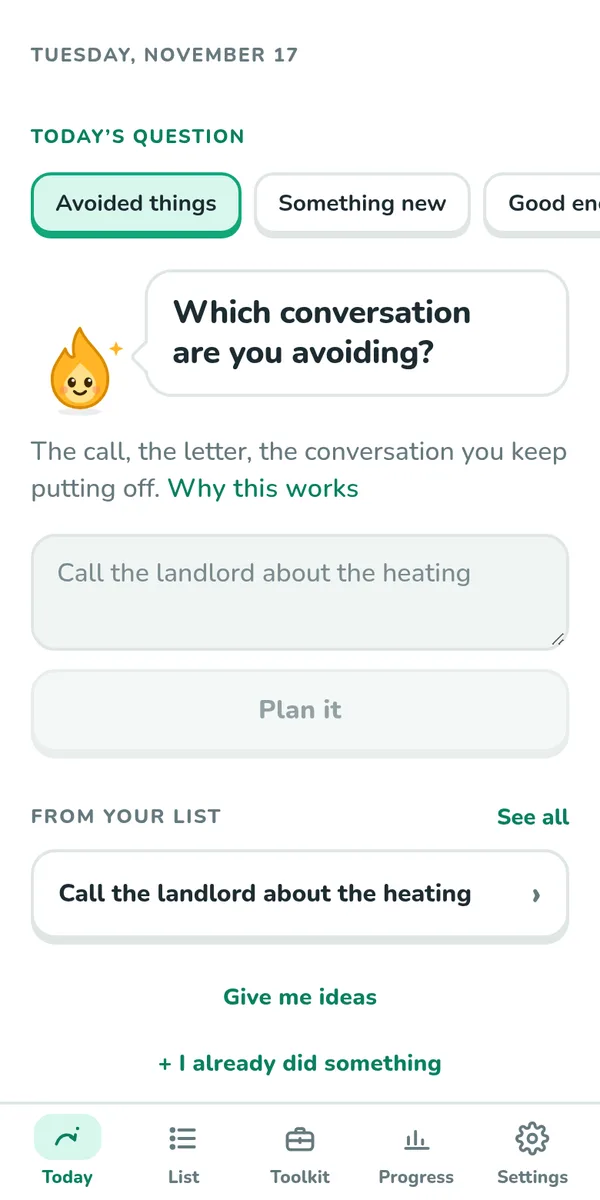 1Pick one thing
A call, an email, a hard talk. As small as you like. Stuck? The app asks you a new question every day.
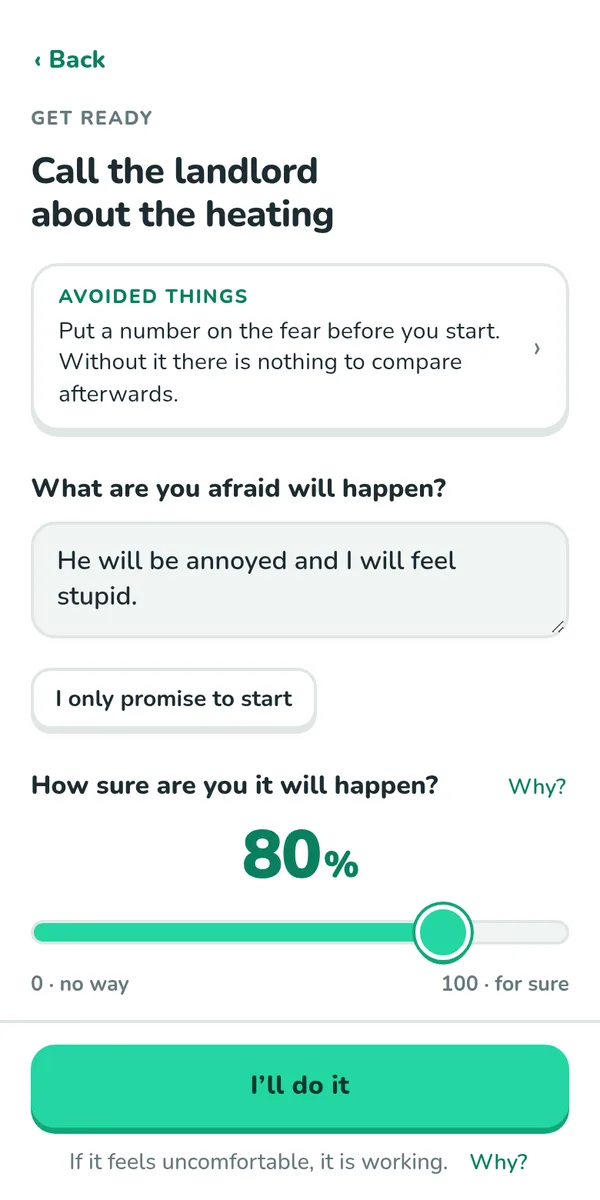 2Guess what will go wrong
Write down your fear and how sure you are. 80%? 30%? That number is the whole trick.
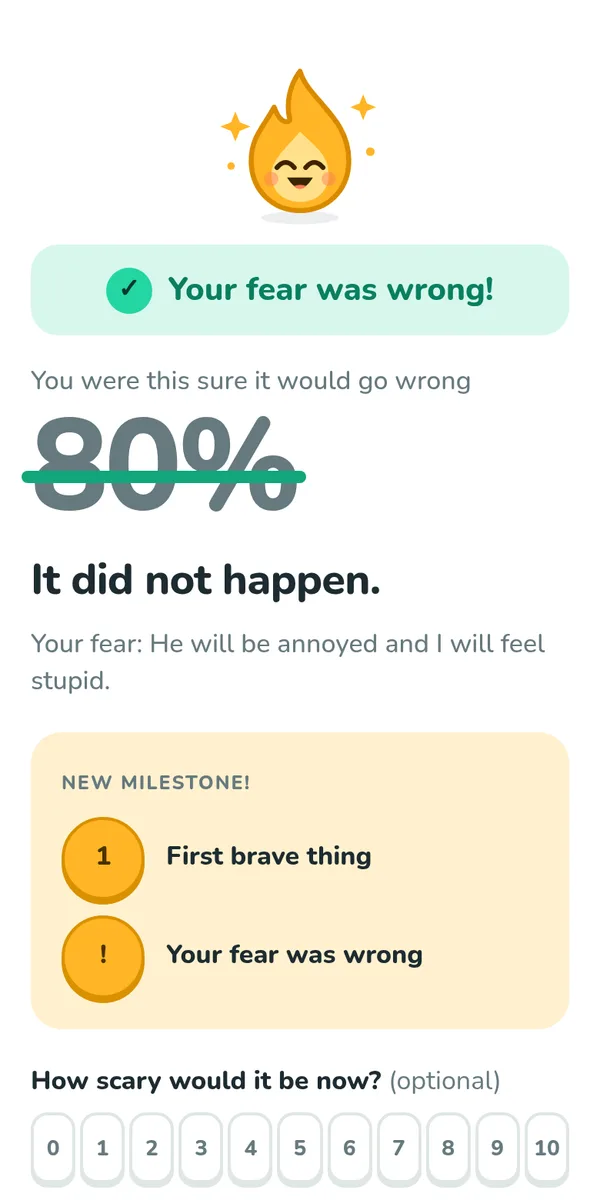 3Do it, then check
Nervous is fine. Afterwards you see your guess next to what really happened. Most of the time the fear was wrong.
The science behind it
Do It Anyway is built on behavioural and cognitive science: the research on how fear, avoidance and confidence work, and the methods therapists use every day. Confidence does not come from telling yourself you can. It comes from proof: doing something you were unsure about and seeing how it really goes.
Your brain guesses what will go wrong, and the guess feels like a fact. Say “80% sure” first, then look at what happened, and the next guess gets more honest.
Craske et al. 2014Putting something off brings relief, and relief works like a reward. So you put it off again, and the fear is never tested.
Krypotos et al. 2015People who decide beforehand “if this happens, then I will do that” reach their goals clearly more often. 94 studies say so.
Gollwitzer & Sheeran 2006The strongest source of believing in yourself is having done something hard. Not praise, not pep talk.
Bandura 1977In the app, every tool shows the study behind it and how strong the evidence is. Where it is thin, we say so.
What is in the toolkit
Seven tools. Each does one job, and each has research behind it.
Before you do it, write down what you fear and how sure you are. Afterwards you see your guess next to what really happened.
Six kinds of questions help you find the thing you are avoiding today, from a hard talk to something new.
Collect what you are putting off, rate how scary each thing is, and break big ones into smaller first steps.
Decide beforehand what you will do when the hard moment comes: “If my voice shakes, then I will keep talking.”
Too big? Promise only the first two minutes, on a timer. Then you may stop. Starting counts.
Every time your fear was wrong, it goes into a collection. Read it before the next hard thing.
A weekly review and a short check-in every two weeks show you what you did and what changed.
Why it works
Every claim links to its source, and we say how strong it is. No miracle promises.
No streaks to protect. No points. Rest days are part of it.
Your notes are private. You can save a copy or delete everything at any time.
Questions
Does it cost anything?
Right now everything is free, and there are no ads. If paid extras come later, we will say so clearly first, and what you wrote stays yours.
Is this scientifically proven?
The methods are. They come from cognitive behavioural therapy and research on motivation, and many have been tested in dozens of studies. The app itself has not been tested in a study yet. We say that openly, and we mark how strong the evidence for each tool is.
Is this therapy?
No. It is self-help, built on methods therapists use. If you are struggling, please talk to a professional. The app tells you where to find help.
Who can read what I write?
Only you. Your notes are saved in your account so they work on all your devices. You can delete everything at any time.
Do I have to install something?
No. It runs in your browser. If you like, add it to your Home Screen and it opens like an app.
What if I skip a day?
Nothing happens. There are no streaks and no points. You pick up where you left off.
Does it work without internet?
Yes, once you have opened it. Your notes are saved to your account when you are back online.
Add it to your Home Screen and it opens like any other app, even without internet.
iPhone: open this page in Safari, tap Share, then “Add to Home Screen”. Android: open the browser menu and tap “Install app”.